Jo-Mei Lee, The Lithe Return
Blog post description.
ART IN TAIWAN
After returning from a residency in Australia in 2015, the artist Jo-Mei Lee drew many long vertical pencil lines on a roll of watercolor paper. The varied pattern of light and dark composed by these lines resembled either a “forest of trees” or the texture of a tree trunk. The artist was not in a hurry to finalize the title of this work. When it was exhibited in the group exhibition "The Allegory of Objects" at the See Art Gallery in Taipei (October 29 - December 3, 2016), it was titled “Straight Line Forward” (2016), with only one section of the roll exposed and hanging on the wall like a vertical scroll. At that point, she had completed only one-third of the scroll.
Later, she finished the remaining blank sections of the paper roll during her residency in Hualien in 2021. When she exhibited the work at "The Poetic Realm"(Yu-Hsiu Museum, June 26 - December 5, 2021), it was displayed again as the same part-concealed vertical scroll, but with a new title. This work, “She’s Lying Down” (2016-2021), was also shown in this solo exhibition, “The Lithe Return.”
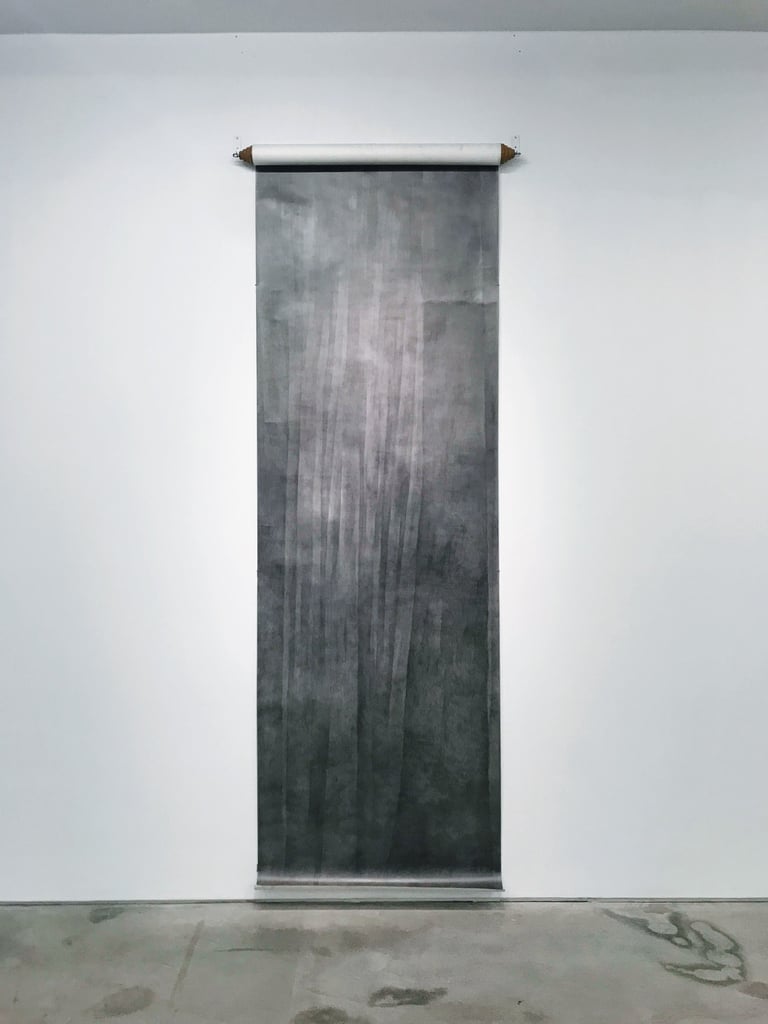
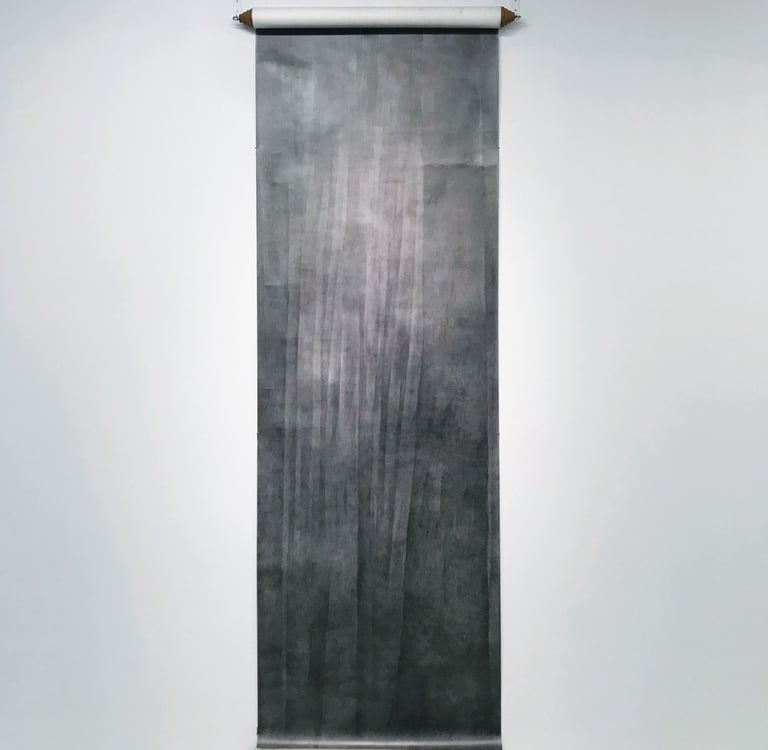
She’s Lying Down 2016 -2021 Watercolor paper, pencil, leftover timber 400 x 97.5
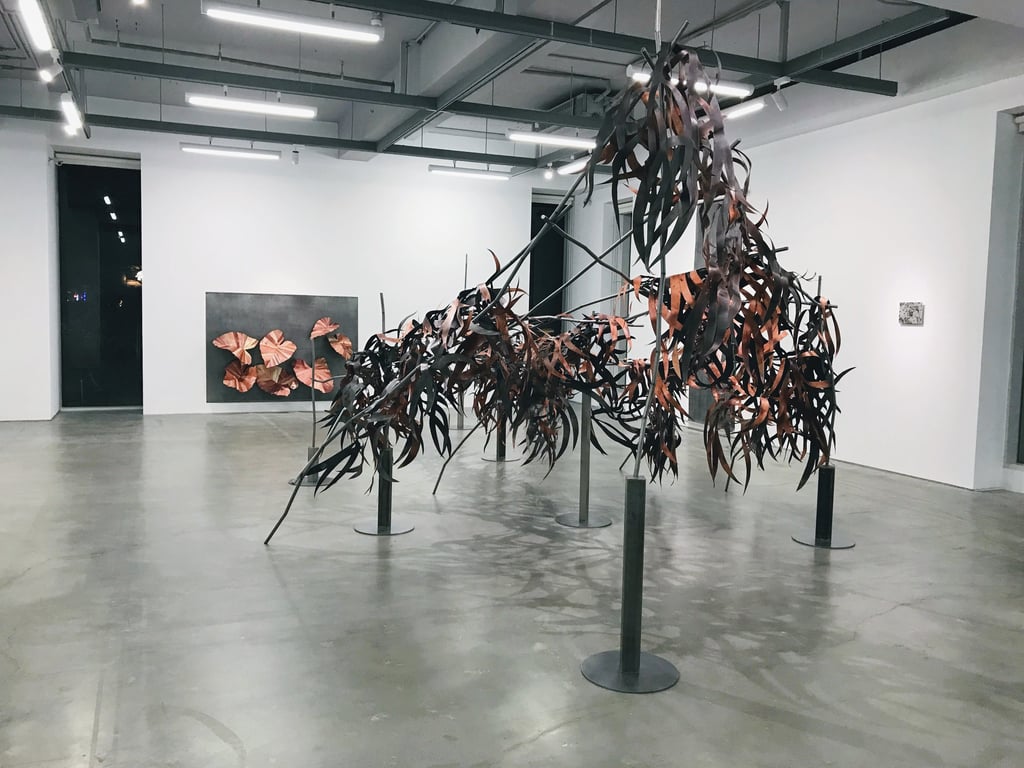
Alongside these links to other works, the shape of the trellis was crafted to follow the grown shape of Acacia leaves rather than being a conventional pre-built rectangle structure commonly found in gardens, thus making Grandma's aging body and memories seem to be gently lifted by Grandpa's trellis.
Many critics have highlighted the empirical observations or the context of colonial context that are implicit in Li's botanical works. However, I think the artist also uses time and memory as a kind of scale. She uses this scale to measure the sensual aspect of plant life, which is often overlooked by botanists, and adeptly navigates the complex historical intersections between romanticized images of natural themes and the objectification of subjects in fieldwork.
Plants do not merely exemplify colonial landscapes; their interactions with humans serve as a crucial biological metaphor for colonial discourse. For instance, the terms “殖民” (colonizing people) and “植民” (planting people) are often used interchangeably in documents from Taiwan's Japanese colonial period (1895-1945). The latter term originated from the Dutch word “Volkplanting,” which translates to "settlement." As colonialism progressed, its meaning expanded to encompass "colonizing," as seen in the word “植民地(colony)”.
Plants, people, and colonial politics have intertwined, leading to respective outcomes. While the relationship between humans and colonial politics is easier to realize—illustrated by the Yaeyama story in the artist's 2009 solo exhibition "Ishigaki Island" (Pingpong Art Space, Taipei, April 11, 2009 - May 3, 2009)—the role of plants is more complex. The role of plants, however, is more complex. Plants are often granted a human-like status only in the context of jokes or challenges directed at vegetarians: if animals are living beings and should not be eaten, then why eat vegetables, since plants are alive as well? Through this ironic logic, plants can be imagined as beings with life cycles — they are born, grow, fall ill, and die — and as subjects exposed to environmental and political forces and their consequences.
The artist's sampling-based approach made her plants resemble still-lifes and thus highlights the various roles and fates of plants in human and colonial societies. While the king coconuts in her previous works are a telling example of how the colonial regime deliberately introduced the plant to create the tropical image of the Southern Country, the Alocasia odora in "A Leaf Shelter"(2022), a wild plant that thrives on the urban fringe outside the control of formal landscaping schemes, is equally moving. Here, the unfolding and folding, opening and closing of plants' leaves mirror movements of massage, the body's response, as well as the lifestyle of plants, perhaps the withered and scorched leaves of the Acacia, the fruition of country almond, the blossoming coconut flower, or the curling buds of the fern.
These works delve into the intimate yet often overlooked relationship between plants and people that has its own historical and social construction and, of course, the power and beauty inherent in the laws of nature. The artist once described traveling by train to the Sherbrooke Forest in eastern Melbourne after completing her residency in Sydney, Australia. It was an impromptu journey, and she was drenched from the rain and alone in the dark forest, surrounded by countless tall eucalyptus trees. However, she felt not the slightest fear but a sense of lighthearted exuberance.
This journey occurred on November 10th, 2015, the date she later used to title a screen-like format work, “November 10th Walk in the Sherbrooke Forest” (2016). Since then, this artwork, like “She’s Lying Down,” has sometimes appeared in exhibitions alongside her new works, highlighting that the folding and unfolding, and the motif of plants, are now the most important aspects of the artist's work, in which family stories and colonial histories flit in and out.
The darkness in the forest seems to emerge as the dominant tone in these later botanical works, in which it is not difficult to evoke the impression of death or passing away—but it also embodies a moment devoid of fear. This duality, like the pair of acacia leaves arranged as wings and their gentle gesture, and the charred reddish-black body in "Garden, Body, Leaves 01, 02", may also convey the artist's mundane wish to lift death and take it on, with gentleness.
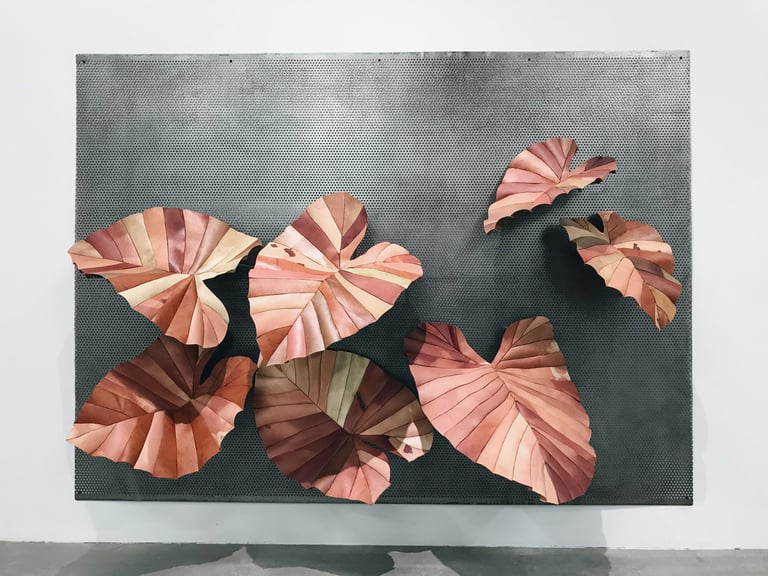
A Leaf Shelter Watercolor paper, natural dye, metal 153.5 x 210 x 48.5 imensions variable Commissioned installation of Guandu Nature Park Present- 2022 Guandu International Art Festival
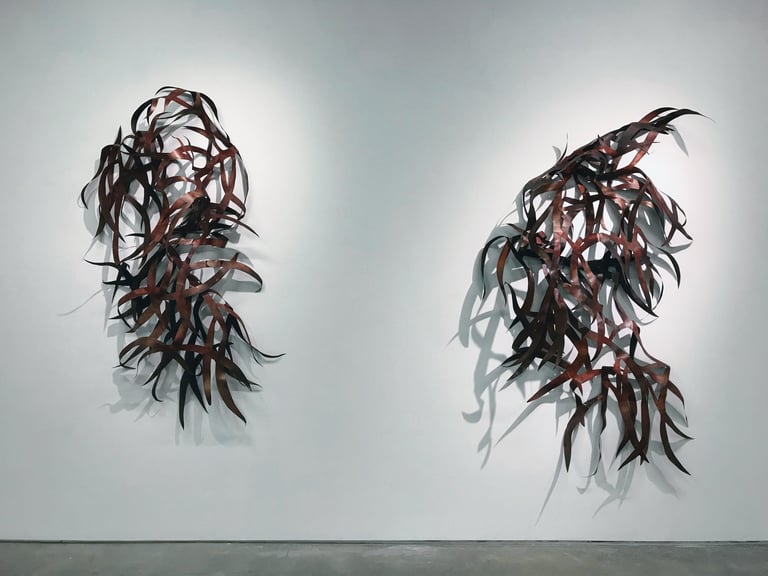
Garden, Body, Leaves 01-02 Watercolor paper, natural dye, toner charcoal, pigment, dirt, iron fillings, pencil 100 x 300
This change of title reflects not only the artist's right to determine the final appearance of the work but also that she insisted on embedding each stage of the production process within the current meaning of the piece, whether or not it is visible in its display. The significance of "She’s Lying Down" lies not only in the unrolled surface of formal expression but also in the rolled-up portion of the paper, which encapsulates numerous unrolling and rolling-up gestures in its making. While the artist repeatedly depicts the tree, she also intertwines family memories with the plant. This includes the shadow of once-existing king coconuts, the genuine eucalyptus forests, the withered and tender Acacia leaves, as well as the moments spent with family members, the palm gestures in each message, and the memories that have been shared repeatedly. Each botanical artwork serves as a deliberate exploration of past moments.
The plants are light and carry the weight of these meanings with ease. In “I Do Take Care of Her Gently” (2022), the artist uses Acacia leaves to symbolize the hardship in her grandmother's life. This stems from the artist's personal experience of living with her and routinely massaging her sore spots over the years. Similar to these sore spots, the Acacia leaves in this piece may appear densely scattered, but their overlapping parts merge into a continuous form that resembles a shadow of these leaves. This concept is also evident in the "Landscape Remains" series, which presents the shadows of vanished plants.
These works are meant to be touched and remembered. When "I Do Take Care of Her Gently" was first installed in the exhibition “Chheng-chhun niá (Youth Peak)” at the Xinying Cultural Center in Tainan (2022.3.25-4.24), the leaves were suspended from the ceiling with transparent wires. In this exhibition, however, they were supported by an iron frame made specifically for the work. Crafted in her father's iron factory, the frame evokes the thin bamboo poles of the loofah trellis that once stood in her grandfather's garden. These elements connect the work to the artist's earlier practice. She was used to creating a series of works inspired by the garden left behind by her grandfather, titled “A Mountain Full of Clear Clouds” (Tamtam Art Taiwan, Taipei, 2013.9.14-10.6). The numbered labels on each thin iron bamboo pole also recall the numbering on the tips of leaves in “Remaining Landscape - 00” (2019) and “Template” (2020).