Hong Tong the Bourgeois: The Unexpected Repercussion of Conservative Nativism and Its Subsequent Silence
ART IN TAIWAN
1.
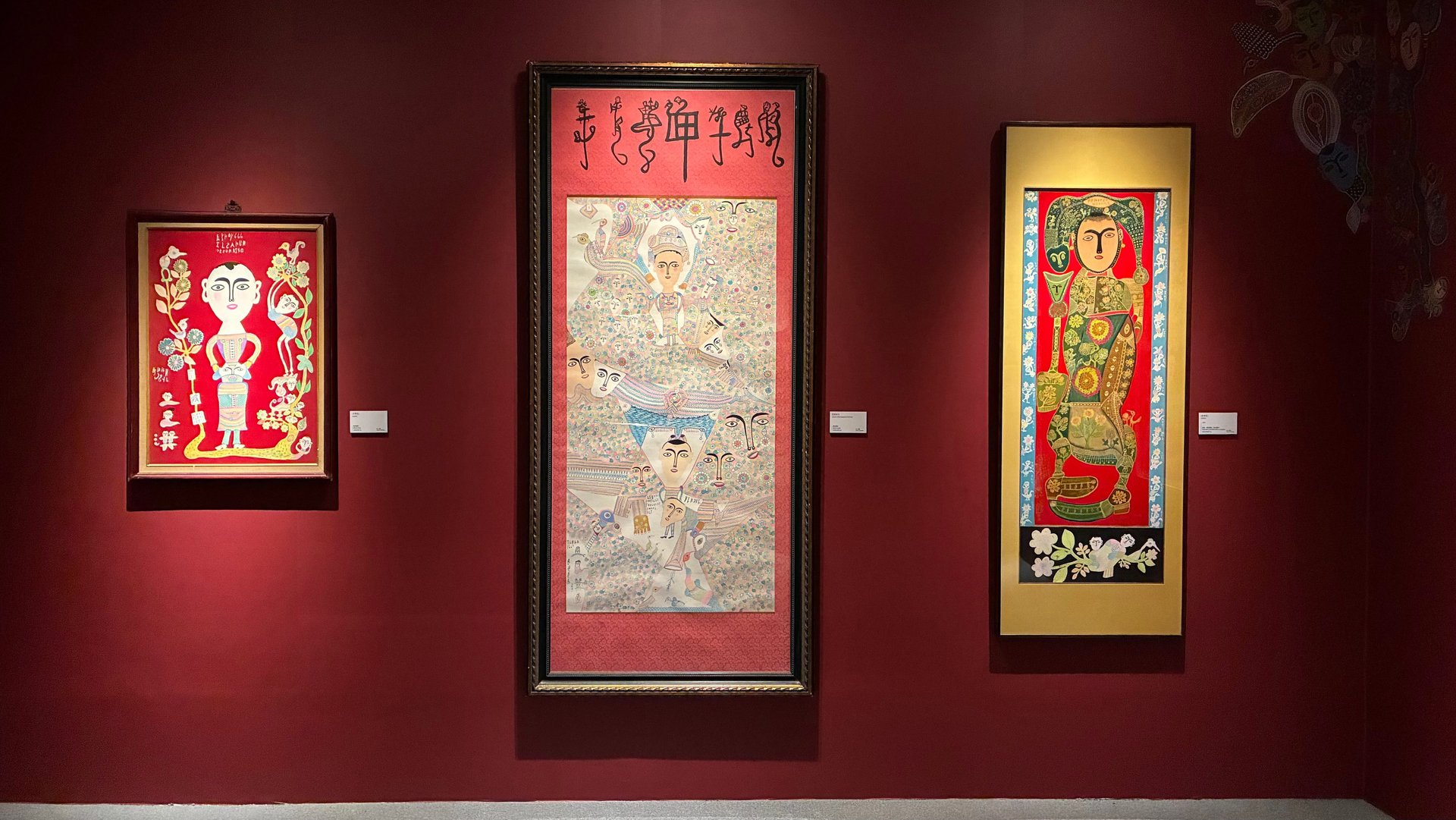
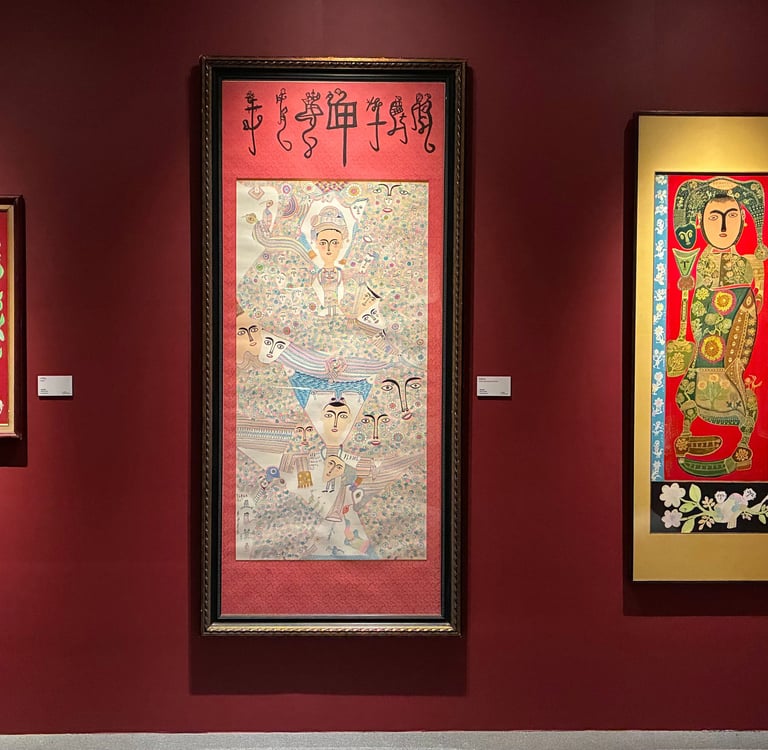
The artist Hong Tong occupies a unique position in Taiwanese art history, yet his true significance remains misunderstood. While he is variously labeled as a “mad,” “mystical,” or “naïve” artist, such terms obscure the complexities of his life and art.
Beyond these labels, few have seriously examined Hong Tong's life from a trans-generational perspective. To illustrate this, we might describe his journey thus: born in 1920 alongside those artists in Taiwan in the Japanese colonial period, yet facing an entirely different supportive environment. After his parents passed away before he turned four, Hong Tong's grandmother took him to live with an uncle. He earned his daily meals by herding cattle and doing odd jobs. Then, in 1927, at the age of seven, Hong Tong was unable to attend public school like other children. At a time when the famous three Taiwanese artists were selected in the Taiten Exhibition for the first time, he was likely still sitting atop a cow's back. Later, after the Pacific War erupted in 1937, the now-adult Hong Tong traveled south to Kaohsiung, working as a laborer under Japanese forepersons on construction sites. Like those of many artists, his wartime years remain a locked chest—let alone the upheavals of the postwar era. [1]
After the war, Hong Tong returned home and married Liu Laiyu. The couple toiled for seven or eight years to buy a small, barren plot of land, while their home remained borrowed. [2] During this period, under the ROC government's crude “Mandarin” policy, he and most local Taiwanese suddenly became illiterate. Not so-called "naivety,” he never abandoned learning opportunities. As a response to the policy, he enrolled in a basic-level public education class—a type of supplementary educational institution that varied greatly in quality for the ‘illiterate’ masses. It was likely there that he learned the Zhuyin phonetic system, a system used exclusively in the ROC, and practical vocabulary. The signature “Hong Tong, Republic of China,” which later appeared in his works, was probably the unfortunate fruit of this learning. [3]
Much literature has speculated on Hong Tong's mental state. [4] In fact, Hong Tong faced multiple life crises just as we do, and he weathered them all. According to writer Yang Qingchu, around 1969, a tenant refused to allow Hong Tong to place his parents' spirit tablets in the house. Feeling he had dishonored his ancestors, Hong Tong suffered a mental breakdown. After recovering, he resolved to become the artist we have known. [5]
This obsession with traditional faith worsening to mental disorder reflects Hong Tong's fundamentally conservative and superstitious nature, a trait that also influenced his creative process. From the moment Hong Tong resolved to become an artist, he distanced himself from his wife in living, believing women to be “impure” during menstruation. After gaining fame, he declared his desire to “take a concubine,” seemingly unconcerned about the implications for Liu Laiyu, who bore the household burden by selling incense at the Five Kings Temple for years.
Hong Tong's character was a product of a traditional patriarchal society. This manifested not only in his exploitation of women but also in his unquestioning political compliance—traits starkly at odds with the later constructed avant-garde image of “Hong Tong the Artist.” [8] Though the Republic of China never lifted him from abject poverty, he remained profoundly grateful for the occasional charity of power. When Tainan County Magistrate Gao Yu-jen and Provincial Social Affairs Director Hsu Shui-te visited Hong Tong's home on behalf of Provincial Chairman Hsieh Tung-min, announcing plans to build him a house, Hong Tong painted three works on the spot for them—one of which was forwarded to Hsieh Tung-min. [9] On June 4, 1976, then Premier Chiang Ching-kuo visited Hong Tong during an inspection tour of Beimen Township. Though bedridden, Hong Tong joyfully rose to greet him, declaring that after his second solo exhibition, he would dedicate his work, Hong Kong Is China's [sic.]Shoe, to Chiang Ching-kuo. [10]
This compliance constitutes a form of “false consciousness,” preventing the oppressed from recognizing that the oppressors created the tools of oppression and exploitation, or causing them to adopt the oppressors' perspectives unconsciously. [11] This false consciousness, cloaked in the rhetoric of economic development, successfully obscured the realities of life under authoritarian rule during the White-terror period in Taiwan. The regime needed only to offer minor concessions to the lower classes to make them forget they could overthrow the Nationalist government once more, like in China.
Hong Tong was indeed a product of grassroots rural culture, yet this rural culture is no idyll; In reality, it oppressed him when he sought to change his life path. It deemed him not to be doing a normal job, let alone offering assistance, simply because he transgressed the boundaries of contentment with poverty and the class divisions created by false consciousness. Hong Tong's acquiescence to patriarchy made him both perpetrator and victim. When he unexpectedly entered the bourgeois cultural sphere, the art world of the time could accept him only crudely, never seriously examining the realities of so-called rural life.
2.
The reasons behind Hong Tong's sudden shift to artistic creation at age fifty remain a subject of debate, though it is often described that he “suddenly frenzied painting.” [13] In truth, his life choices still followed the imaginative conventions of the artistic ecosystem. Hong Tong was not like the “artist Hong Tong” who neither needed nor desired to learn, nor was he indifferent to fame and fortune. On the contrary, though self-taught at fifty, he yearned for formal training. He frequently visited exhibitions at the Tainan Municipal Social Education Center, later commenting that those shows featured “nothing but Shan-shui or scenery.” [14] He also attended Tseng Pei-yao's studio painting class through the introduction of painter Hong Te-kui, and frequently brought his paintings to seek instruction from the “Teacher Tseng.” [15]
He yearned for recognition. After several years, perhaps influenced by fellow studio students, he began aspiring to participate in exhibitions. Hong Tong was rejected from the Provincial Exhibition. In 1972, he applied to exhibit at the USIS Tainan and the Tainan Municipal Social Education Center, but both declined. Later, when his request to borrow space at the Five Kings Temple in Nan Kunshan to display his paintings was refused, he angrily hung his works along the temple courtyard. There, by chance, he was discovered by a reporter from the then English-language magazine Chinese Voice. [16] The subsequent story is better known: Hong Tong's fame spread rapidly after being featured in China Times and Lion Art, and peaked in 1976 with a solo exhibition at the USIS Taipei, organized by Artist Magazine.[17]
After gaining recognition, Hong Tong reportedly asked artist Tseng Pei-yao, “Why didn't they want my paintings before?” [18] We can now better understand how objects are transformed into potential artworks through the manipulation of the art world. Through media coverage and criticism, Hong Tong's story and work were reduced to a template for the romanticized artist archetype. While this template also mentioned his prior art studies and exhibitions, the emphasis often lay on his “self-taught” status, which intentionally or unintentionally dismantled the contextual connections of the events. It overlooked that Hong Tong had his own vision of an artistic career, and he unexpectedly succeeded in realizing it.
What Hong Tong never anticipated was that he had stepped into the bourgeois art world—a realm he had once imagined, now achieved, yet whose future remained beyond his grasp.
3.
The notion of “self-taught” later shaped most people's understanding of so-called “naïve artists,” often confining them to the realm of academic art education [19] and presupposing that art education or artistic concepts are universal shared resources or common knowledge. In fact, Hong Tong's case clearly demonstrates that so-called amateur artists themselves often cannot navigate the language and conventions of high culture and must rely heavily on the mechanisms and intermediaries of the art world to transform their creations. Just as the nearly illiterate Hong Tong clearly could not, like some others, claim his paintings “inherited and innovated upon the tradition of Chinese painting” and, like other artists, sought out celebrities to write critical reviews for him.
Here, artistic meaning and value are not produced by the works themselves, but by a symbolic system in which knowledge is both power and a form of authority. Although Hong Tong himself created a series of astonishing paintings, he had no voice in interpreting them. Whether praised or disparaged, Hong Tong could only submit to others' judgments or passively resort to his anachronistic preconceptions to cope.
Faced with sudden fame, Hong Tong was caught off guard and even retreated. Before his rise to prominence, his personality was characterized by a blend of self-doubt and pride. After his rapid ascent to stardom, the self-doubt that followed deepened the contradictions within his character. [20] He consistently remained tight-lipped about the meaning behind his paintings, fearing he might reveal the secrets of his creative process. He also harbored resentment toward his works appearing in the media. During his earliest interview with the English-language magazine China Voice, he still allowed reporters to photograph his pieces freely and later even permitted a Taiwan Television reporter to film his painting process. [21] After achieving fame, he removed his paintings from the temple courtyard and began restricting their exposure. After his solo exhibition, Hong Tong grew even more wary of visitors, forbidding anyone from photographing his work. The confusion these behaviors create also reinforces the established image of “crazy artist Hong Tong.” At this point.
In the art circles of that era, the most amusing aspect was how certain painters and those from the Art Department of National Taiwan Normal University automatically cast themselves as the inevitable conservative antagonist in every legend. The art department at NTNU is not an institution for training professional artists but for professional art teachers. At the time, the professors in the department often served as conservative artistic authority on the island of Taiwan. During artist discussions held at Hong Tong's exhibitions, some painters argued that his fame was “unfair to many artists who diligently pursue their craft yet remain unrecognized” [22]. They claimed it misguided young artists and art students, “making them question what approach to painting would resonate with society—is rigorous study even worthwhile?” [23] A Chinese artist, who drew lotus flowers by ink brush on actress Li Xiang's bare back, Zhang Jie, went further, asserting that Hong Tong's paintings were neither cute nor endearing: “If everyone thinks he's a genius, then just invite Hong Tong to future international exhibitions.” [24]
Aside from these discussions, the real Hong Tong endured the grief of his eldest son's death from liver disease just before his solo exhibition, while also confronting relatives with ulterior motives. [25] For some of his same-surnamed kin, pre-fame Hong Tong was known as “the madman,” while post-fame Hong Tong became “the cash cow.” They traveled north in groups to attend his solo exhibition and later sought credit from him afterward. When Hong Tong passed away in 1987, one relative staged a typical rural soap opera-style inheritance dispute.
Beyond these fellow villagers, Hong Tong didn't know whom he could trust. He couldn't grasp the symbolic systems of high culture, nor was he familiar with the conventions of the art economy, which are difficult even for most people. Hong Tong naturally hoped to improve his life through his art, but the methods he employed were equally antiquated. After his solo exhibition, perhaps encouraged by the decent sales of his painting postcards, he began printing cards at home to sell, incurring significant losses. [28] In some sale cases, he also inherited the pretentious practice of Chinese literati painters, selling works under the guise of gifts to Liang Ma-kuo, a renowned English tutor who was baffled by the “A Gift With Respect” inscription on the painting at the time. [29]
Unsurprisingly, some newspaper commentaries at the time viewed Hong Tong's refusal to sell paintings as the “artistic integrity” of “Artist Hong Tong.” Conversely, when his paintings failed to sell, other commentaries mockingly criticized him for being out of touch, suggesting he had missed his opportunity. [31] These condescending critiques utterly ignored Hong Tong's predicament. His inability to sustain himself through art brought him more trouble than fame: a constant stream of visitors incurred significant social expenses. At the same time, his reputation prevented him from taking odd jobs as before. Earlier, it was mentioned that Chiang Ching-kuo once visited Hong Tong. As Chiang prepared to leave, he remarked, “You're not without money; you simply refuse to accept it.” At that time, the works Hong Tong kept locked away in a chest at home had already been transformed into commodities with economic value, preventing his wife, Liu Laiyu, from applying for poverty relief subsidies.
6.
Artists like Hong Tong require immense patience and trustworthy agents. Yet even setting aside Hong Tong's personal circumstances, after his passing, his third son, Hong Shibao, and figures from the art and cultural spheres discussed establishing a foundation and museum. Ultimately, various environmental factors delayed its founding. [33] In Taiwan, private art museums struggle to sustain themselves, even for renowned senior artists like Li Shih-ch'ao, Chen Chin, Li Mei-shu, and Yang San-lang. Plans to preserve Hong Tong's former residence, much like the studios of Li Shih-ch'ao and Liao Chi-chun, ultimately met the same fate: disappearance.
After Hong Tong's passing, his achievements were recognized through several retrospective exhibitions. In 2008, the Grand Kun Garden, a Chinese-style garden, opened as an extension of the Wuwang Temple in Nankunshan, and its basement was established as the Hong Tong Memorial Hall.[34] Without any paintings, the hall features a statue of Hong Tong recreating his original exhibition setting in the temple courtyard for visitors to view. Meanwhile, the art establishment created categories like “naive art” or “naive artists” after his death. However, an overemphasis on academic training has led to a situation in which anyone who hasn't studied painting at an art academy or a regular university but has the financial means to publish an art book seems to qualify as a naive artist. Particularly in a 2007 retrospective exhibition on Hong Tong, the list of amateur artists attributed to him included Hsu Wen-lung, the chairman of Chi Mei Corporation, and his wife. [35]
Every system, when pushed to its extreme, inevitably invites its opposite. When the art establishment packaged Hong Tong as “Artist Hong Tong,” it was fundamentally to make him more recognizable to a specific class of viewers, not even to make him more understandable. Yet after co-opting him, the art world neither fully recognized Hong Tong as a truly artistic challenge. The reason is perhaps not hard to grasp: asking bourgeois painters who constantly lament their poverty to learn from the near-destitute Hong Tong would inevitably feel like condescension.
During his lifetime, Hong Tong had some connection with the French painter Jean Dubuffet (1901–1985). In 1978, the Lausanne Museum of Art approached him through an intermediary, inviting him to exhibit. Hong Tong, who was bitterly frustrated by the poor sales of his paintings at the time, declined the invitation. Later, Dubuffet personally wrote to Art Magazine expressing his deep admiration and desire to acquire Hong Tong's works. He made this promise:
His [Hong Tong's] works will undoubtedly be understood, cherished, and revered here, just as he hopes they will be. Their future value is also fully guaranteed. [36]
Setting aside postcolonial discourse, the art environment in ROC simply could not deliver such a promise. From the 1940s onward, Dubuffet began noticing the works of marginalized figures. His own creative practice drew inspiration from them, evolving into an “anti-cultural” artistic orientation that ultimately became his lifelong vocation. In contrast, even during ROC's fervently patriotic 1970s and subsequent localization movement, the prevailing environment framed Hong Tong solely through bourgeois artistic frameworks—either accepting or rejecting him.
7.
Hong Tong's works once led audiences to imagine all manner of impossible imagery. These images, by chance, were introduced into bourgeois cultural circles at the time, shocking the conservative art world. In fact, this was likely Hong Tong's original motivation and purpose for creating art. From the moment he decided to become an artist, he was clear about his intent to create a style distinct from what was commonly seen at the time, and to produce unprecedented visual imagery.
Yet he never imagined that such a simple aspiration could so easily unsettle the tedious, superficial artistic styles and institutions of his time. The art world of the 1970s and beyond had an opportunity to develop a broader perspective through Hong Tong's example—one that engaged with artistic creation and social conflict—thereby cultivating genuinely pioneering and subversive creative conditions. Unfortunately, they failed to recognize the exploitation of grassroots culture by high culture, let alone understand that in a bourgeois society that had not ceased its exploitation, offering Hong Tong more money and material resources was merely a form of false generosity. Greed and money alone cannot foster cultural development. The so-called localization art movement, which followed in the footsteps of literature, soon lost momentum. For an art establishment that habitually emphasizes pure art, this outcome was perhaps inevitable.